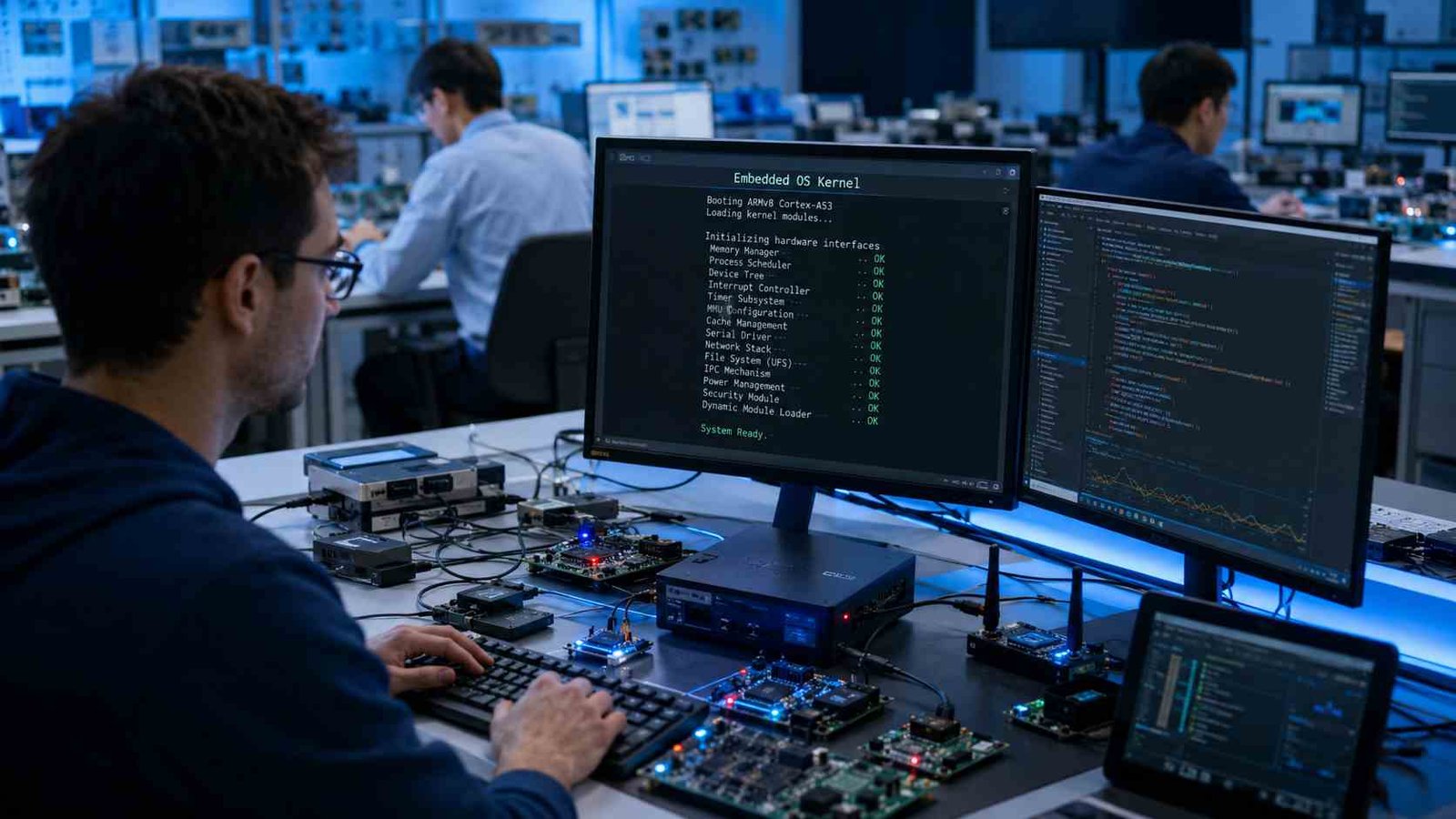
 A tiny fitness tracker on your wrist. A smart thermostat quietly learning your routine. Even the braking system inside a modern car. Most people never think about the operating systems running behind these devices, yet they’re doing an incredible amount of work every second.
And here’s the part that surprises many engineers the first time they dig into embedded systems: most of these devices can’t afford to waste memory, power, or processing cycles. A bulky desktop-style operating system simply wouldn’t survive there. That’s why modular OS kernels for embedded devices have become such a big deal over the last few years.
The shift feels almost invisible from the outside. But inside the tech industry, it’s changing how connected products are designed. Companies building IoT sensors, industrial robots, medical wearables, and automotive electronics now care deeply about flexibility at the kernel level. Not because it sounds impressive on a marketing slide. Because it saves memory, improves stability, and makes updates far less painful.
Linux Foundation reports continue to show embedded Linux adoption growing across automotive and industrial sectors, especially where long-term customization matters. Meanwhile, smaller RTOS platforms like FreeRTOS and Zephyr are pushing modular design even further by allowing developers to load only the pieces they actually need.
Funny thing is, this idea isn’t really about adding more software.
It’s about removing everything unnecessary.
That mindset defines modern embedded engineering.
Why Embedded Systems Need Lightweight Operating Systems
Embedded devices live under strict limitations. They often have tiny processors, limited RAM, restricted storage, and tight energy budgets. A smartwatch or industrial sensor doesn’t have the luxury of desktop-class hardware sitting behind the scenes.
Think about a battery-powered medical monitor. It might need to run for days or weeks without charging. Every extra background process drains energy. Every unnecessary kernel component wastes memory.
That changes the way operating systems are built.
Traditional desktop kernels usually include support for hundreds of drivers and features because users expect flexibility. Your laptop might connect to printers, webcams, external GPUs, Bluetooth accessories, or virtual machines all in the same week. Embedded systems rarely work that way. Their jobs are specific and predictable.
A smart washing machine doesn’t suddenly decide to become a gaming PC.
So developers trim the operating system down to essentials.
That’s where modular OS architecture becomes useful. Instead of shipping one giant monolithic kernel packed with every feature imaginable, engineers separate components into modules. The device loads only what it actually needs.
It sounds simple. But the impact is huge.
Smaller kernels boot faster. They consume less memory. They’re easier to secure because fewer components mean fewer attack surfaces. Plus, developers can patch or update individual modules without rebuilding the entire operating system.
You notice this especially in automotive systems. Modern vehicles may contain over 100 embedded controllers handling braking, infotainment, navigation, climate control, and driver assistance systems. Carmakers increasingly use modular Linux-based platforms because updates can be isolated to individual functions instead of risking the whole software stack.
That flexibility matters more now than it did ten years ago.
Because embedded devices are no longer isolated machines sitting quietly in a factory corner. They’re connected. Constantly communicating. Constantly updating.
And honestly, that changes everything.
So What Is a Modular Kernel?
The easiest way to picture a modular kernel is to imagine a toolbox instead of a sealed machine.
A traditional monolithic kernel behaves like one huge block where everything lives together permanently. Drivers, memory management, file systems, networking support, device communication — it all stays loaded whether the device needs it or not.
A modular kernel breaks those features into smaller pieces called modules.
These modules can be loaded, unloaded, updated, or replaced independently.
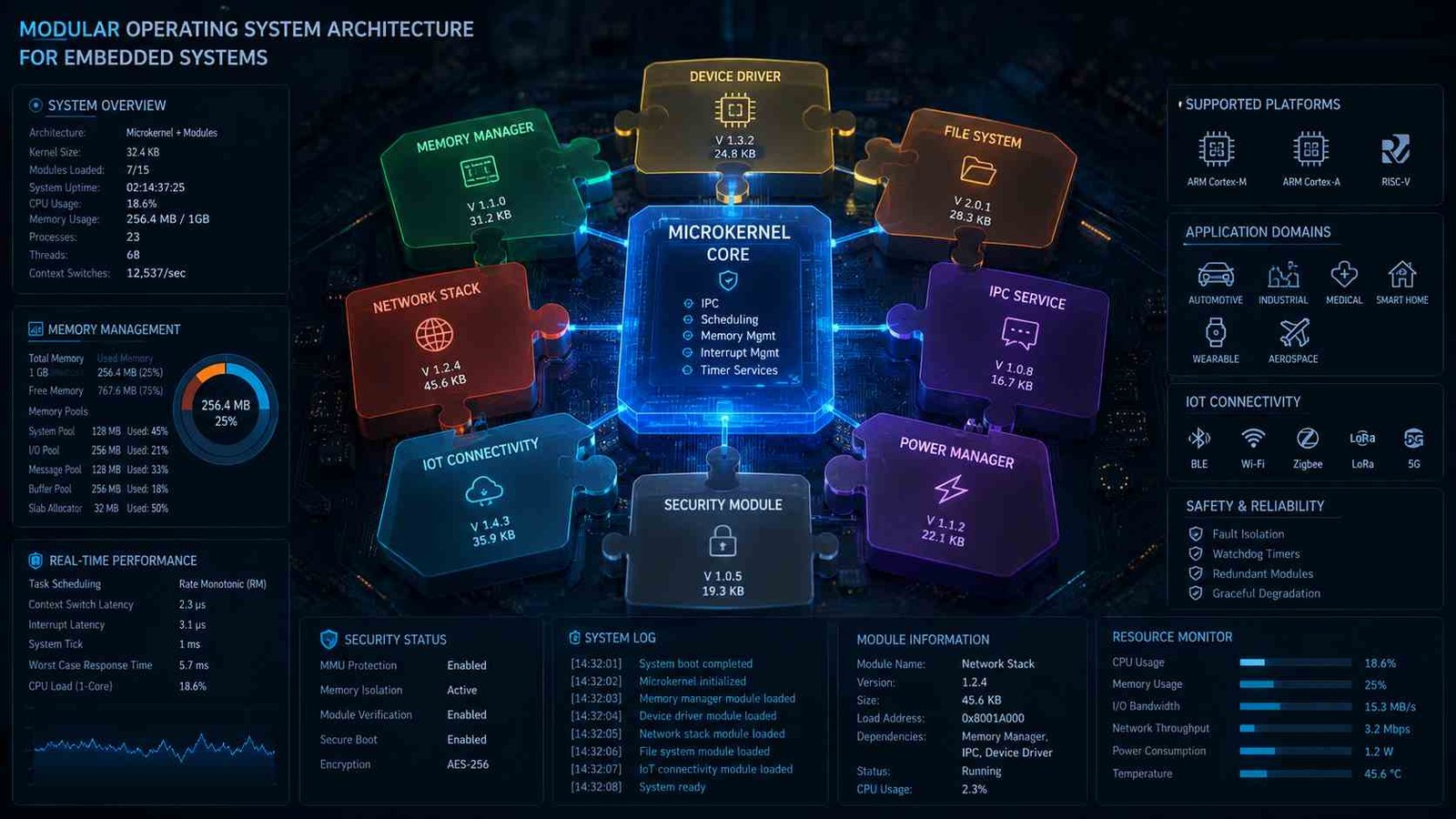
That’s the core idea.
Linux handles this through Loadable Kernel Modules, often called LKMs. Developers can dynamically add functionality while the system is running instead of rebuilding the entire kernel from scratch. Embedded systems benefit heavily from this because hardware requirements often vary between products.
One industrial controller may need CAN bus communication. Another might require Bluetooth Low Energy. A third may only use Ethernet.
Rather than building three separate giant operating systems, developers reuse the same lightweight core kernel and attach only the necessary modules.
Kind of like snapping Lego pieces onto a shared foundation.
Here’s a simplified comparison:
| Kernel Type | Structure | Memory Usage | Flexibility | Typical Use |
|---|---|---|---|---|
| Monolithic Kernel | Everything built together | Higher | Lower | Desktop OS |
| Modular Kernel | Features separated into modules | Lower | Higher | Embedded Systems |
| Microkernel | Minimal core with services outside kernel | Very Low | Very High | Safety-critical systems |
People sometimes confuse modular kernels with microkernels, but they’re not identical.
A microkernel strips the operating system down even further. Only the absolute essentials remain in kernel space, while drivers and services run separately in user space. Systems like QNX and MINIX follow this approach because isolation improves reliability.
Modular kernels sit somewhere between full monolithic designs and microkernels.
That balance is why they’ve become so practical in embedded computing.
What Does Modular OS Mean in Real Life?
This question comes up a lot because the phrase “modular OS” can sound abstract at first.
But you’ve probably already used devices powered by one.
Take a smart home hub. Maybe it supports Wi-Fi, Zigbee, Bluetooth, and voice control. Those communication features are often handled through separate software modules. If the manufacturer later adds Matter protocol support, engineers can deploy a targeted update instead of replacing the entire operating system.
That saves bandwidth, development time, and storage space.
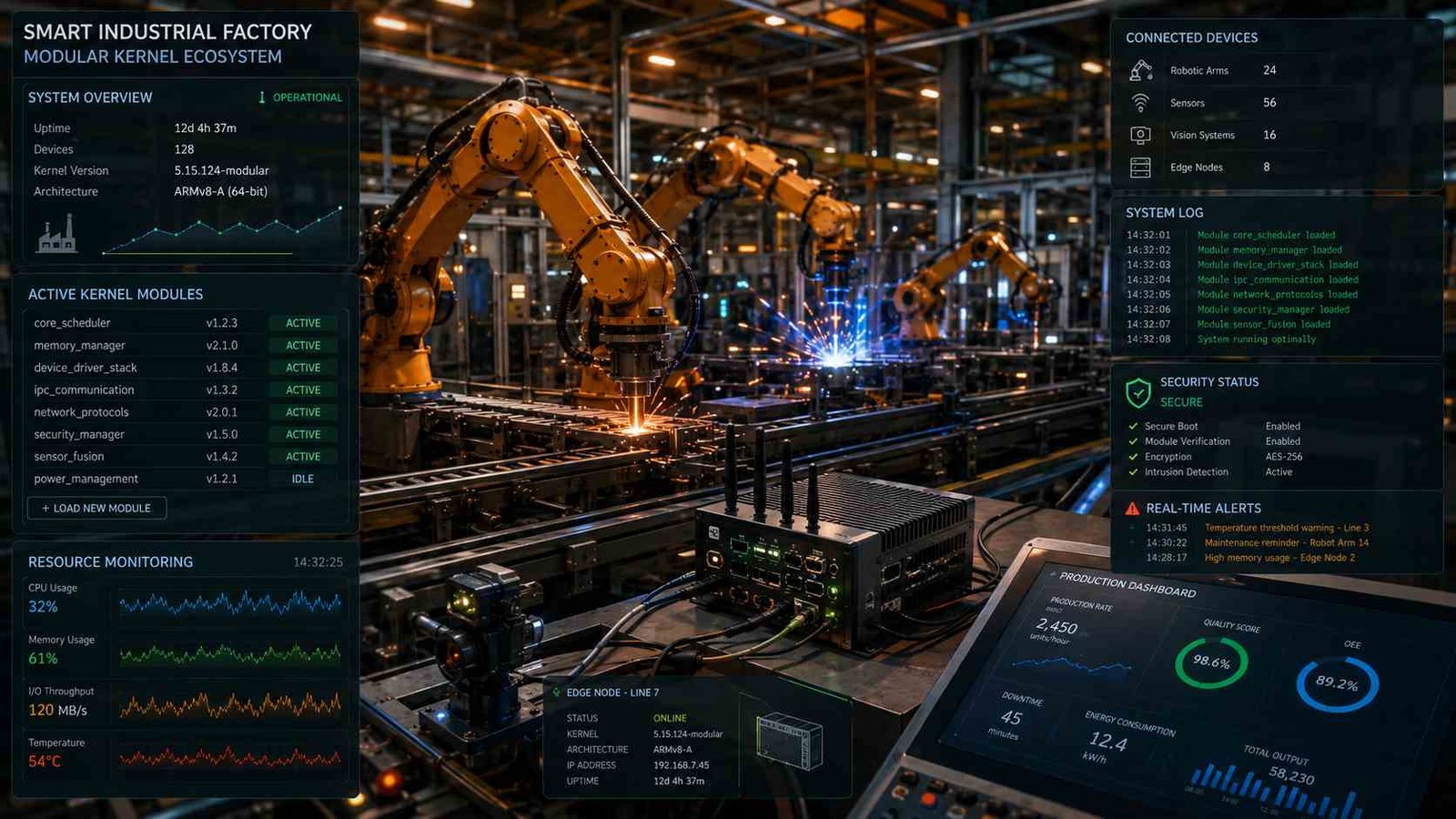
Or think about industrial robotics. One robotics company I spoke with years ago described their embedded Linux platform almost like a restaurant kitchen. Every robot had the same base operating system, but different modules were activated depending on the robot’s role.
Welding robots loaded motion-control modules.
Inspection robots loaded camera-processing modules.
Transport robots loaded navigation stacks.
Same kitchen. Different recipes.
This modular approach also helps during maintenance. If a networking driver crashes, developers may restart or replace that single module rather than rebooting the entire machine.
That’s incredibly important in environments where downtime costs money.
Factories notice every second.
Hospitals do too.
And there’s another reason modular operating systems matter now: cybersecurity.
Security teams increasingly prefer isolated functionality because vulnerabilities become easier to patch. Instead of shipping massive firmware replacements, vendors can distribute focused module updates targeting only affected components.
That reduces risk.
A lot of embedded engineers quietly consider modularity one of the biggest practical improvements in modern device design, even if consumers never hear about it.
The Kernel’s Job Inside an Embedded Device
People often hear the word “kernel” and imagine something impossibly technical hiding deep inside a machine.
But the kernel is really just the manager.
It controls communication between hardware and software.
That’s the simplest way to describe it.
In embedded systems, the kernel handles several essential tasks:
- Memory management
- Device communication
- Task scheduling
- Hardware abstraction
- Security permissions
- Interrupt handling
- Power management
Without the kernel, applications wouldn’t know how to interact with processors, sensors, displays, or storage devices.
Imagine a smartwatch trying to monitor your heartbeat while also displaying notifications and syncing with your phone. The kernel decides which tasks get processor time and how resources are allocated.
And embedded devices often need real-time responses.
A delayed Instagram notification isn’t catastrophic.
A delayed airbag deployment absolutely is.
That’s why many embedded systems use Real-Time Operating Systems, commonly called RTOS platforms. These operating systems prioritize predictable timing over raw computing power.
FreeRTOS, Zephyr, VxWorks, and QNX are popular examples.
Some modular kernels are optimized specifically for real-time performance. They keep the kernel core small and predictable while allowing optional functionality through modules.
You can almost think of it like a carefully organized workshop. The essential tools stay within arm’s reach. Everything else gets stored nearby until needed.
That organization reduces overhead.
And in embedded systems, overhead is the enemy.
Why Linux Dominates Embedded Modular Kernels
Linux quietly became one of the most important embedded operating systems in the world.
Not flashy Linux desktop installations with glowing RGB keyboards. The stripped-down versions running inside routers, smart TVs, cars, drones, medical scanners, and industrial controllers.
Billions of devices now depend on embedded Linux systems.
And modular kernel architecture is a huge reason why.
Linux gives developers enormous flexibility. Engineers can customize kernels to match exact hardware requirements while removing unnecessary components. That matters when a device only has a few megabytes of memory available.
Plus, Linux already supports thousands of drivers and hardware platforms.
That ecosystem saves companies years of development time.
A startup building agricultural IoT sensors doesn’t need to reinvent networking stacks from scratch. They can adapt existing kernel modules, optimize the operating system, and focus on product-specific features instead.
The Linux kernel also supports dynamic module loading. Drivers can be added or removed during runtime, making development and maintenance far easier.
You’ll see this heavily in automotive systems now.
The Software-Defined Vehicle movement is pushing car manufacturers toward modular Linux architectures because vehicles increasingly behave like rolling computers. Features arrive through over-the-air updates instead of physical hardware replacements.
Tesla accelerated this expectation. Other automakers followed.
And here’s something interesting many casual readers miss: embedded Linux isn’t always large.
People often associate Linux with desktop environments like Ubuntu or Fedora. But embedded builds can be extremely lean. Developers regularly strip kernels down to minimal footprints tailored for specific processors and tasks.
One engineer once compared embedded Linux to camping gear.
“You only pack what you’re willing to carry.”
Honestly, that’s probably the best explanation I’ve heard.
What Kernel Modules Actually Do
Kernel modules extend functionality without rebuilding the entire operating system.
Simple idea. Massive implications.
These modules typically handle:
| Module Type | Purpose |
|---|---|
| Device Drivers | Communicate with hardware |
| File System Modules | Manage storage formats |
| Network Modules | Handle communication protocols |
| Security Modules | Enforce protection policies |
| Power Modules | Optimize battery and energy use |
| Sensor Modules | Connect cameras, GPS, accelerometers |
Suppose a company develops a smart traffic camera.
The base kernel may only include core scheduling and memory management. Then developers add modules for video encoding, Ethernet communication, infrared sensors, and AI-based object detection.
Later, if they upgrade the camera sensor hardware, they may only replace one driver module rather than redesigning the entire system.
That modularity shortens product cycles dramatically.
And products evolve faster than ever now.
I’ve seen embedded teams treat modular architecture almost like insurance. Nobody fully knows what future hardware changes or protocol updates will appear two years down the road. Modular kernels keep systems adaptable.
Especially in IoT environments.
Because the moment a connected device ships, it starts aging.
New security standards appear. Wireless protocols evolve. Hardware vendors change chipsets. Suddenly that “finished” product needs new capabilities.
A modular operating system handles those transitions far more gracefully than rigid firmware designs.
Where Modular Kernels Show Up Every Day
You probably interacted with multiple modular embedded systems before breakfast today.
They’re everywhere.
Some examples include:
Smart Home Devices
Smart speakers, thermostats, security cameras, and connected lighting systems rely heavily on lightweight modular operating systems. These devices constantly communicate across changing ecosystems of apps, protocols, and cloud services.
Manufacturers need flexibility because standards evolve quickly.
Matter support is a great example. Many companies rolled out compatibility updates through modular software components instead of replacing entire systems.
Automotive Electronics
Modern vehicles contain embedded systems controlling navigation, safety systems, infotainment, battery management, and autonomous driving assistance.
Automotive Linux platforms increasingly use modular architectures because isolated updates reduce system-wide risks.
And honestly, cars now resemble distributed computing platforms more than traditional mechanical machines.
Industrial Automation
Factories use embedded controllers for robotics, monitoring systems, machine vision, and predictive maintenance tools.
Downtime becomes expensive fast.
A modular kernel allows maintenance teams to patch specific components while minimizing disruptions.
Medical Devices
Portable diagnostic tools, infusion pumps, wearable heart monitors, and patient tracking systems often require strict reliability with limited hardware resources.
Microkernel-inspired modularity improves fault isolation, which matters enormously in healthcare.
Nobody wants a noncritical module crash affecting life-support functionality.
Aerospace and Defense
Satellite systems and avionics frequently use highly modular real-time operating systems where reliability and fault containment matter more than flashy user interfaces.
One failure cannot compromise the entire system.
That design philosophy shapes everything.
Why Developers Prefer Modular Designs
Here’s something you hear often from embedded developers after years in the field:
Complexity always grows.
No matter how carefully systems are designed, requirements expand over time. New sensors appear. Customers request integrations. Security regulations evolve.
Rigid operating systems struggle under that pressure.
Modular designs adapt more naturally.
Developers gain several practical advantages:
Easier Maintenance
Teams can patch individual components instead of rebuilding massive firmware packages.
That saves time.
It also reduces deployment risk.
Smaller Memory Footprint
Only necessary modules remain loaded, reducing RAM and storage consumption.
For constrained embedded hardware, that matters enormously.
Better Hardware Flexibility
One operating system core can support multiple products with different features.
This dramatically lowers development costs across product lines.
Faster Debugging
When systems are modular, engineers isolate failures more easily.
A broken networking module doesn’t automatically implicate audio drivers or power management systems.
Improved Security Isolation
Smaller active codebases generally reduce attack surfaces.
And targeted updates improve vulnerability response times.
The cybersecurity angle has become especially important recently.
Embedded devices used to exist quietly in isolated environments. Now they’re online constantly. Routers, industrial controllers, home appliances, cameras — all connected.
Attackers notice that.
Manufacturers do too.
The Rise of Real-Time Modular Operating Systems
One trend gaining serious momentum in 2025 and 2026 is hybrid modular RTOS architecture.
That sounds technical, but the goal is surprisingly human.
Predictability.
Devices increasingly need real-time responsiveness while also supporting cloud connectivity, AI processing, and over-the-air updates. Traditional real-time operating systems weren’t originally built for this level of complexity.
So developers evolved them.
Platforms like Zephyr now combine lightweight modularity with real-time scheduling, security isolation, and scalable networking stacks. The Linux Foundation has heavily supported this ecosystem because IoT growth keeps accelerating.
Edge AI is pushing this even further.
Imagine a security camera analyzing movement locally instead of sending every frame to the cloud. Suddenly the embedded kernel must manage camera hardware, AI acceleration, network communication, and energy efficiency simultaneously.
That’s a lot for a tiny device.
Modular architecture helps distribute those responsibilities cleanly.
And devices are becoming more autonomous every year.
You can almost feel operating systems shifting from static software into living service platforms that evolve continuously after deployment.
That wasn’t normal fifteen years ago.
Now it’s expected.
The Challenges Nobody Talks About Enough
Modular kernels solve many problems, but they also create new ones.
And good engineers usually admit that openly.
One issue involves dependency management. Modules often rely on other modules, and version mismatches can create instability if updates aren’t carefully controlled.
Security also becomes complicated if developers dynamically load untrusted components.
Then there’s testing.
Embedded systems already require enormous validation work. Modular architectures multiply possible software combinations, which increases testing complexity significantly.
One developer once joked that modular systems “turn one operating system into fifty tiny operating systems pretending to cooperate.”
Not entirely wrong.
Performance overhead can appear too. Dynamic module loading introduces additional management complexity compared to tightly integrated monolithic designs.
Still, most industries accept those tradeoffs because flexibility matters more now than absolute simplicity.
Especially in connected ecosystems where devices evolve continuously after release.
What the Future Looks Like
The future of embedded operating systems feels less rigid than ever.
Artificial intelligence workloads are moving onto edge devices. Smart factories want adaptive automation. Vehicles increasingly rely on software-defined architectures. Medical devices continue shrinking while gaining new capabilities.
All of this pushes embedded systems toward greater modularity.
And there’s another shift happening quietly in the background.
Open-source collaboration.
Linux, Zephyr, FreeRTOS, and other modular embedded platforms benefit from huge developer communities sharing drivers, networking stacks, security patches, and optimization strategies. That collaborative momentum accelerates innovation far faster than isolated proprietary systems used to.
We’re probably heading toward embedded operating systems that behave more like customizable ecosystems than fixed firmware images.
Tiny devices will continue becoming smarter, more updateable, and more interconnected.
But interestingly, the winning systems may not be the ones with the most features.
They’ll likely be the ones designed with restraint.
Small kernels.
Efficient modules.
Focused functionality.
That discipline keeps embedded systems reliable.
And reliability still matters more than hype.
A Quiet Revolution Happening Inside Tiny Machines
Most people never see operating system kernels. They don’t think about module loaders or scheduler priorities while adjusting a thermostat or unlocking a smart car.
But these hidden systems shape modern life more than we realize.
Modular OS kernels for embedded devices have become one of the foundations of connected technology because they solve real engineering problems without demanding oversized hardware. They make systems lighter, safer, easier to maintain, and far more adaptable to change.
And change arrives quickly now.
Maybe that’s the fascinating part. The smartest embedded systems aren’t trying to do everything at once. They’re carefully choosing what belongs inside the kernel and what can remain flexible around it.
A bit like good engineering finally learning the value of simplicity.

Paul Thurrott is a trusted tech journalist known for clear, accurate reporting on operating systems, updates, and security. He breaks down complex changes into simple insights so readers can understand what truly affects their devices.