 A few years ago, most team chat apps quietly trained us to depend on the cloud for everything. Every message, reaction, file, and call had to bounce through a distant server somewhere before reaching the people sitting right next to us. It worked fine… until it didn’t.
You’ve probably seen it happen. A Slack outage hits during a deadline. Microsoft Teams freezes in the middle of a client call. Someone’s internet drops for ten minutes and suddenly they’re cut off from the whole conversation. Remote work made those little cracks impossible to ignore.
That’s why local-first team chat apps are getting serious attention in 2026.
The idea sounds technical at first, but it’s actually pretty human. Your messages live on your device first, not only in a company cloud. The app keeps working even when your connection gets shaky. Changes sync later when the internet comes back. Think of it like writing notes in a notebook that still exists even when the Wi-Fi dies.
And honestly, once you use a good local-first system, traditional chat apps can feel strangely fragile.
The shift is bigger than convenience. Companies now care deeply about privacy, ownership of data, offline productivity, and faster communication between distributed teams. Developers care too. They’re tired of waiting for centralized servers to catch up with modern workflows.
That pressure has pushed a new generation of messaging platforms into the spotlight.
Some focus on encrypted peer-to-peer communication. Others combine local databases with cloud sync. A few are trying to replace the entire “always online” collaboration model altogether.
And the funny thing is, this movement isn’t really about chat apps.
It’s about trust.
Why Traditional Team Chat Started Feeling Heavy
Cloud-first messaging solved a huge problem back in the early remote-work boom. Teams needed shared conversations across offices, countries, and devices. Centralized platforms like Slack and Microsoft Teams made that possible.
But centralization comes with tradeoffs people didn’t fully notice at first.
Every message has to travel through company servers. Notifications depend on remote infrastructure. Search indexes live somewhere else. Even your typing indicator usually depends on a network round trip.
That sounds tiny until your connection becomes unstable.
I noticed this during a train trip last year while testing offline collaboration apps. My document editor kept working perfectly because it stored changes locally first. Meanwhile, my team chat completely stopped functioning the second my mobile signal dipped.
That contrast stuck with me.
One tool respected the reality of modern work. The other assumed perfect internet all the time.
Local-first apps flip that assumption around.
Instead of treating the cloud as the “main brain,” these systems treat your device as the primary source of truth. The cloud becomes a sync layer rather than the center of existence.
That changes everything:
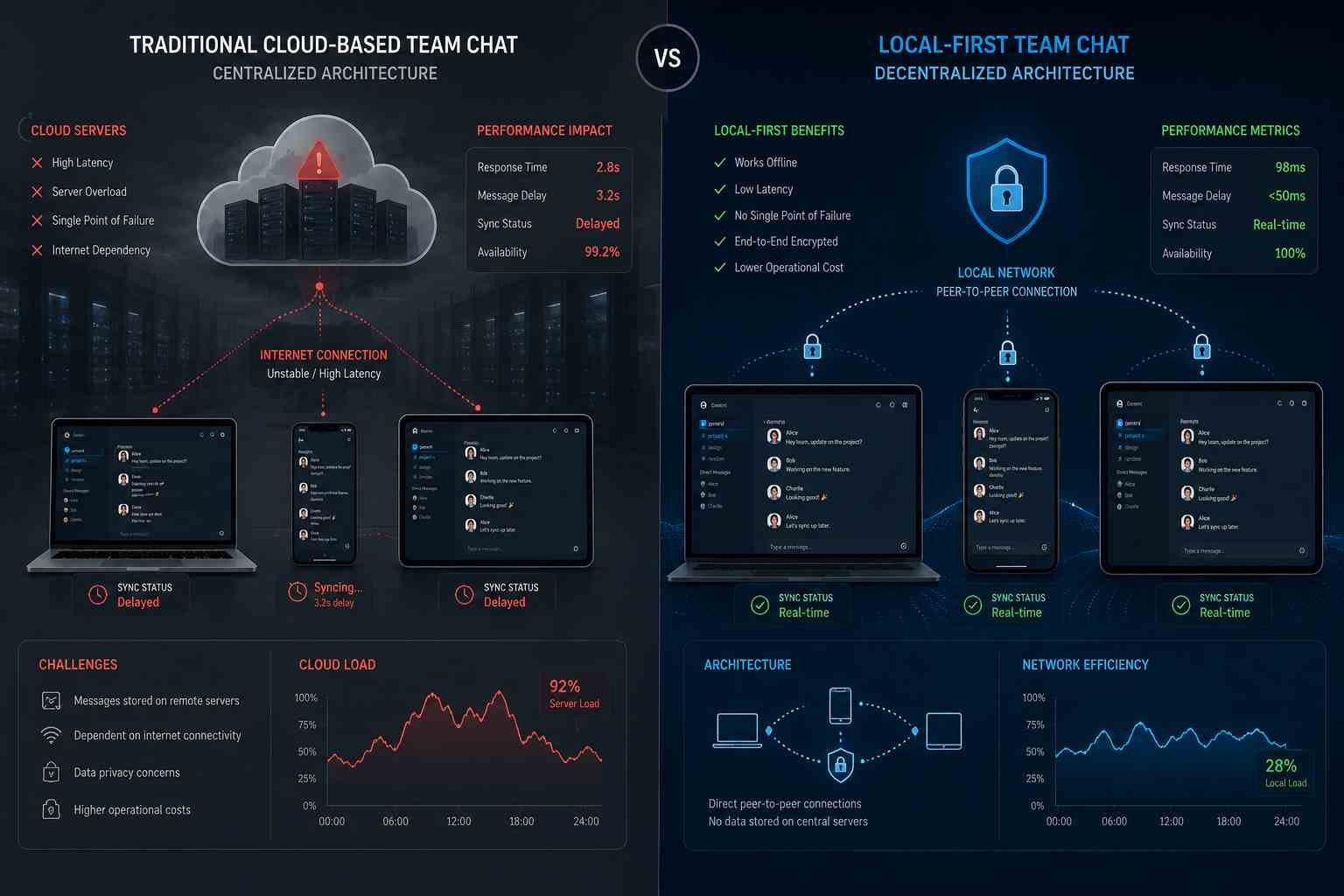
| Traditional Cloud Chat | Local-First Chat |
|---|---|
| Requires stable internet | Works offline |
| Server-dependent | Device-first storage |
| Slower sync during outages | Fast local response |
| Centralized data control | More user ownership |
| Higher server reliance | Peer-to-peer possibilities |
The difference feels subtle at first. Then you hit your first outage and realize your workflow barely changed.
That’s the moment people “get it.”
So What Does “Local-First” Actually Mean?
The phrase sounds more intimidating than it really is.
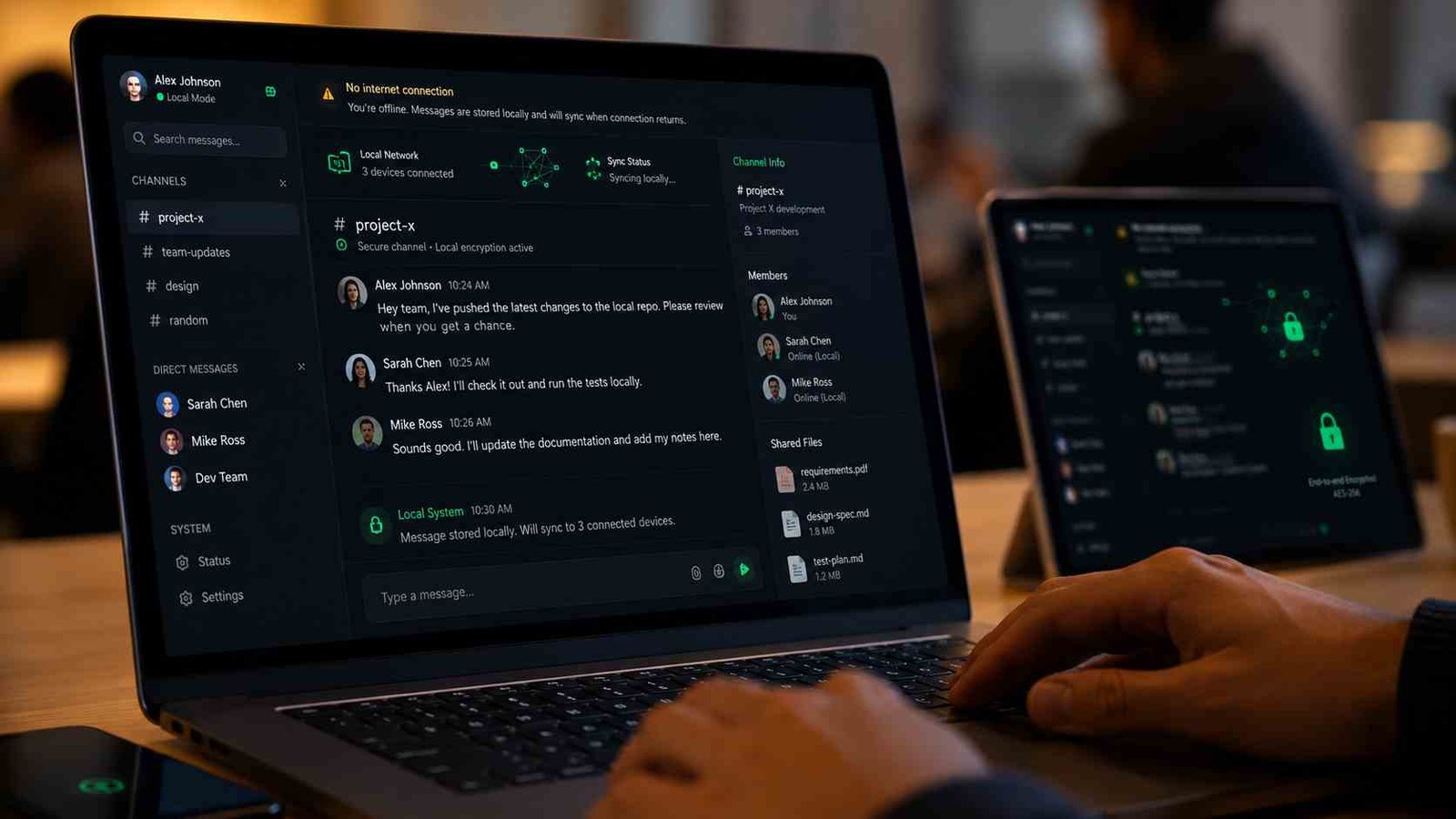
A local-first app stores your information directly on your own device before syncing it elsewhere. Messages, edits, reactions, and files are immediately available locally. Syncing happens quietly in the background whenever connections allow it.
Picture two coworkers in the same office sending messages over a local network even if the wider internet goes down.
That’s the spirit behind it.
The local-first movement became more visible after developers like Martin Kleppmann and Ink & Switch pushed for software models that prioritize ownership, resilience, and offline capability. Their work influenced modern collaboration tools far beyond chat systems.
And you can feel that influence now.
Some modern team apps behave almost like smart notebooks. They remember everything locally. They sync changes carefully. They avoid locking your work behind constant server dependency.
The best part? Most users don’t even notice the technical complexity underneath.
You just open the app and it works.
That’s good software design.
A lot of current systems combine several technologies behind the scenes:
- Local databases
- Conflict-free replicated data types (CRDTs)
- Peer-to-peer sync
- End-to-end encryption
- Distributed caching
- Offline synchronization engines
Sounds complicated. But here’s a simpler way to think about it.
Imagine your team chat app acting like a really organized assistant carrying a local copy of your workspace everywhere you go. When connections return, it politely compares notes with everyone else and updates itself.
No panic. No lost drafts.
Just continuity.
The Privacy Angle People Are Paying Attention To
Privacy conversations around workplace tools changed dramatically after several high-profile security incidents and AI-data concerns between 2024 and 2026.
Businesses started asking uncomfortable questions:
Who owns our conversations?
Can AI systems train on internal discussions?
What happens if a cloud provider gets breached?
Can employees work securely in sensitive industries without exposing everything to centralized infrastructure?
Local-first systems don’t magically solve every security problem. But they reduce certain risks in meaningful ways.
Some apps store encrypted local message histories that never fully rely on external databases. Others use decentralized protocols where organizations host their own infrastructure instead of depending entirely on third-party providers.
That’s part of why protocols like Matrix gained momentum among governments, developer communities, and privacy-focused organizations.
Signal’s influence matters here too. Signal showed millions of people that encrypted communication could feel smooth and approachable rather than overly technical.
And once users experience private messaging done well, expectations change fast.
You start noticing which platforms feel invasive.
A friend working in cybersecurity told me his company shifted internal discussions away from large cloud platforms after realizing just how much metadata could still be collected even when message content stayed encrypted.
That realization hit hard.
Because privacy isn’t only about secrecy anymore. It’s about control.
Who gets to decide where your conversations live?
The Rise of Offline Work Culture
Remote work changed office culture. Hybrid work changed infrastructure expectations.
But unstable internet still exists everywhere.
Coffee shops. Airports. Trains. Hotels. Rural areas. Shared coworking spaces. Even expensive corporate offices during network maintenance.
And people are tired of losing productivity because of it.
That’s where local-first team chat apps quietly shine.
I tested one developer-focused collaboration tool earlier this year during a storm-related outage. The internet dropped completely for almost forty minutes. Messages between nearby coworkers still moved through the local office network. Notes kept syncing between devices. Drafts stayed searchable.
Nobody stopped working.
You don’t realize how psychologically calming that feels until you experience it firsthand.
Traditional cloud systems often create invisible anxiety. You’re always waiting for confirmation that your actions reached a remote server somewhere. Local-first tools remove some of that tension because your work exists immediately on your own machine.
That responsiveness matters more than people think.
And the technical world is noticing.
According to developer surveys published across GitHub discussions and distributed systems communities in 2025, offline-first collaboration became one of the fastest-growing priorities for productivity tool developers.
Makes sense.
Modern work doesn’t happen in perfect environments anymore.
Software finally started adapting to real life instead of demanding the opposite.
The Apps Leading This Shift
No single app dominates the local-first category yet. The space still feels early and experimental in some areas. But several platforms are shaping the conversation.
Here are some of the most important names right now.
Matrix-Based Platforms
Matrix isn’t exactly one app. It’s an open communication protocol powering multiple messaging systems.
That flexibility matters.
Organizations can host their own servers while still communicating across the broader Matrix ecosystem. It’s a bit like email for modern chat platforms.
Apps such as Element built around Matrix have become popular among privacy-focused teams, governments, and open-source communities.
Strengths include:
- Decentralization
- End-to-end encryption
- Federation support
- Self-hosting options
- Strong developer ecosystem
The learning curve can feel steeper compared to Slack, though. Especially for non-technical teams.
Still, Matrix keeps gaining credibility because organizations increasingly want communication independence.
Signal for Small Teams
Signal isn’t technically a workplace collaboration suite, but plenty of small businesses use it for secure communication.
And honestly, I understand why.
It’s fast, private, simple, and trustworthy.
The app stores messages locally and prioritizes encryption heavily. While it lacks advanced enterprise workspace features, many teams prefer that simplicity over bloated communication ecosystems.
There’s also something refreshing about software that doesn’t constantly push integrations, AI assistants, and engagement metrics at you.
Sometimes people just want reliable conversation.
Tailscale and Local Network Collaboration
Tailscale isn’t a chat app either, but it supports the infrastructure philosophy behind local-first communication.
By creating secure mesh networks between devices, Tailscale allows teams to connect systems directly across locations without exposing everything publicly.
A growing number of local-first collaboration tools now build around similar networking principles.
The cloud becomes coordination.
Not dependency.
That distinction matters more each year.
Emerging Peer-to-Peer Platforms
Several startups are now experimenting with fully peer-to-peer collaboration systems where conversations sync directly between devices.
These tools often prioritize:
- Local databases
- CRDT synchronization
- Minimal cloud storage
- Distributed backups
- AI-assisted offline search
Some remain developer-focused for now. Others are slowly becoming polished enough for mainstream workplaces.
Feels a bit like the early days of cloud collaboration itself.
Messy. Promising. Not fully settled yet.
Why Developers Love Local-First Architecture
Developers tend to spot infrastructure weaknesses before regular users do.
They notice latency.
They notice failed syncs.
They notice fragile backend systems.
That’s partly why local-first architecture became such a respected movement among software engineers.
When apps store data locally first, performance often feels dramatically smoother. Search becomes faster. Typing latency drops. Loading screens shrink. Offline capability stops being an afterthought.
And users feel that difference instantly, even if they can’t explain why.
There’s another reason developers care so much.
Ownership.
Many engineers became frustrated watching software move toward increasingly locked-down ecosystems where users rent access rather than truly possess their own information.
Local-first systems push back against that trend.
They give users more direct access to their own data structures, synchronization logic, and portability.
That philosophy overlaps heavily with open-source culture.
You can see it in projects connected to:
- Matrix
- Automerge
- Yjs
- ElectricSQL
- Replicache
These frameworks focus on resilient synchronization between devices instead of constant server dependency.
And honestly, some of the engineering behind this stuff is beautiful.
Not flashy-beautiful.
Quietly reliable beautiful.
The kind that makes software feel trustworthy.
The Catch Nobody Should Ignore
Local-first systems sound amazing on paper. But they’re not magic.
And this is where a lot of hype articles become unrealistic.
Building reliable synchronization between multiple devices is incredibly hard.
Really hard.
Imagine three people editing conversations simultaneously across unstable connections while maintaining encryption, message ordering, search indexing, and conflict resolution.
Now imagine scaling that across thousands of devices.
That’s why many local-first apps still struggle with:
- Sync conflicts
- Storage overhead
- Battery usage
- Complex backup recovery
- Enterprise compliance requirements
- Multi-device consistency
Sometimes the “offline-first” dream introduces its own complexity headaches.
I’ve tested early-stage collaboration apps that felt brilliant for two days and then completely confused themselves after reconnecting from offline mode.
You could almost hear the synchronization engine panicking.
The good platforms hide that complexity gracefully. The weaker ones expose it immediately.
And businesses care deeply about reliability.
Especially larger organizations.
That’s why fully decentralized workplace communication probably won’t replace mainstream cloud platforms overnight. Hybrid systems are more likely in the near future.
Cloud where useful.
Local where essential.
That balance feels realistic.
AI Is Quietly Changing Team Chat Too
You can’t talk about modern collaboration software in 2026 without mentioning AI.
But the relationship between AI and local-first systems is surprisingly interesting.
A lot of businesses now want AI-powered summaries, search tools, and meeting assistance. At the same time, they don’t want sensitive company data constantly flowing into external AI infrastructure.
That tension created a new opportunity.
Some local-first platforms now experiment with on-device AI processing instead of fully cloud-based intelligence.
Small language models running locally can:
- Summarize chats
- Organize notes
- Suggest replies
- Search conversations semantically
- Prioritize urgent messages
Without always uploading raw conversations externally.
That’s a major shift.
Apple’s push toward on-device AI processing influenced this direction heavily. So did broader concerns about enterprise data privacy.
And honestly, local AI feels different.
Faster sometimes.
More personal too.
It’s almost like your computer understands your workspace without constantly reporting back to a distant server farm.
There’s still plenty of cloud dependency involved today, of course. But you can already see where things are heading.
Smaller models.
Smarter sync.
More local intelligence.
Less constant exposure.
What Businesses Actually Care About
Tech enthusiasts often focus on architecture philosophy. Businesses usually focus on practical outcomes.
Fair enough.
Most companies evaluating local-first team chat apps care about a few simple questions:
Will this reduce downtime?
Will it improve security?
Will employees actually use it?
Will it integrate with existing workflows?
Will it save money long term?
That last point matters more lately.
Cloud costs have climbed significantly for large organizations managing massive communication archives. Local-first architectures can sometimes reduce infrastructure pressure because devices share part of the storage and synchronization workload themselves.
Not always. But often enough to matter.
Compliance is another growing factor.
Healthcare organizations, legal firms, financial companies, and government agencies increasingly want communication systems with stronger control over data residency and retention policies.
Self-hosted or decentralized systems become attractive there.
Then there’s reliability.
A cloud outage affecting millions of users simultaneously feels far more dangerous today than it did five years ago because modern businesses depend so heavily on real-time communication.
That dependency created demand for systems that degrade gracefully instead of collapsing entirely.
Local-first apps fit that mindset naturally.
Is There Really a “Best” Team Chat App?
One of the LSI questions asks: “What is the best team chat app?”
Honestly, that depends completely on your team.
There isn’t one universal winner.
Here’s a more realistic breakdown.
| Team Type | Best Fit |
|---|---|
| Enterprise office environments | Microsoft Teams |
| Startup collaboration | Slack |
| Privacy-focused organizations | Matrix / Element |
| Small secure teams | Signal |
| Developer-heavy teams | Discord or Matrix |
| Offline-sensitive environments | Local-first collaboration tools |
The interesting part is that the definition of “best” keeps changing.
Five years ago people mostly cared about integrations and emojis.
Now they care about resilience, privacy, AI behavior, and ownership.
Different priorities create different winners.
And honestly, that’s healthy for the software industry.
Can You Earn Money by Chatting?
This question shows up surprisingly often around messaging apps.
The short answer is yes, but not directly because of the chat app itself.
People earn money through communication-based work:
- Remote support teams
- Community management
- Freelance consulting
- Sales communication
- Customer success roles
- Online tutoring
- Moderation jobs
Some creators also monetize paid communities through platforms like Discord, Telegram, and Slack communities.
But local-first team chat apps themselves aren’t usually “money-making apps.” They’re productivity infrastructure.
Think of them like digital office spaces rather than income platforms.
Still, communication quality absolutely affects business performance.
A fast, reliable workspace saves time. And time becomes money pretty quickly inside organizations.
Is There a Future Beyond Cloud-Only Communication?
Feels likely.
Not because cloud systems are disappearing, but because people no longer want total dependence on them.
The future probably looks hybrid.
Part cloud.
Part local.
Part decentralized.
You can already see similar patterns happening elsewhere:
- AI processing moving onto devices
- Password managers using zero-knowledge systems
- Offline-capable document editing
- Edge computing infrastructure
- Distributed storage models
Communication tools are simply joining that broader movement.
And maybe that’s the deeper story here.
People want technology that feels dependable again.
Not fragile.
Not constantly buffering.
Not fully controlled by invisible systems somewhere far away.
Just dependable.
That’s surprisingly emotional when you think about it.
Because communication sits at the center of modern work life. Teams argue there. Collaborate there. Solve problems there. Sometimes even build friendships there.
When those systems fail, work feels disconnected instantly.
Local-first architecture tries to reduce that fragility.
And honestly, it might become one of the most important software design ideas of this decade.
Where Things Go From Here
The next generation of local-first team chat apps probably won’t market themselves primarily as “local-first.”
Most users won’t care about the terminology.
They’ll care that the app feels fast.
That messages appear instantly.
That outages don’t destroy workflows.
That privacy feels believable.
That AI features don’t feel invasive.
That collaboration simply works wherever they are.
The underlying architecture will quietly matter more than the branding.
And maybe that’s the sign of a mature technology trend. The technical philosophy disappears into the experience itself.
You stop noticing the infrastructure because the software finally respects the way humans actually work.
That’s the real shift happening here.
Local-first team chat apps aren’t only changing communication tools. They’re changing assumptions about who controls digital workspaces in the first place.
And something about that feels long overdue.

Paul Thurrott is a trusted tech journalist known for clear, accurate reporting on operating systems, updates, and security. He breaks down complex changes into simple insights so readers can understand what truly affects their devices.